Why is Tap Skier So Addictive?
In the fast-paced digital era, minimalist challenge games often possess the most enduring appeal. Tap Skier is exactly that kind of masterpiece. It features no complex background lore and no tedious upgrade systems—just pure white snow, deadly obstacles, and your near-limit reaction speed.
As a retro 2D-style skiing game, Tap Skier perfectly fuses "simple controls" with "extreme difficulty." You only need one finger to navigate your skier through a mountain full of peril. This article will provide an in-depth analysis of every detail of the game, taking you from a novice beginner to a "King of the Mountain."
Chapter 1: Basic Tutorial — Mastering the Art of the "Zigzag"
1.1 Core Control: Tap to Turn
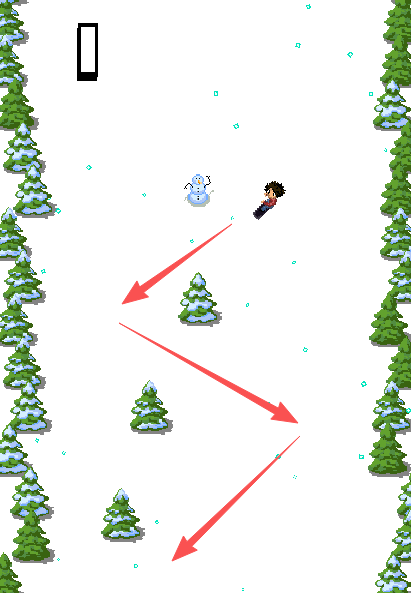
The essence of Tap Skier lies in its single-tap control mechanism. By default, your skier slides at a 45-degree diagonal angle.
Tap the Screen: The skier will immediately change direction. If you are sliding down-right, tapping will make him turn down-left.
Sense of Rhythm: The game isn't about how fast you tap, but how accurately you tap. This "Z-shaped" (zigzag) path is your only means of survival.
1.2 User Interface (UI) Guide
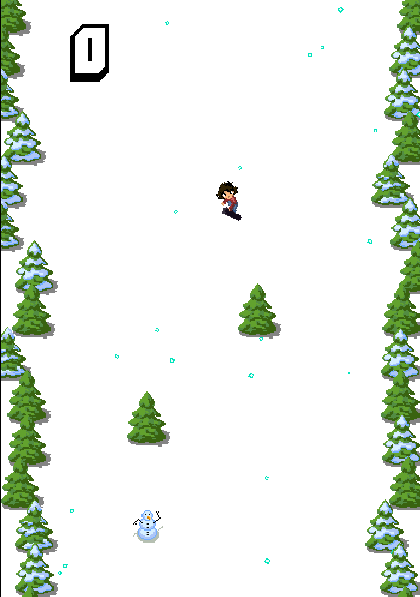
Upon entering the game, you will see a very intuitive UI:
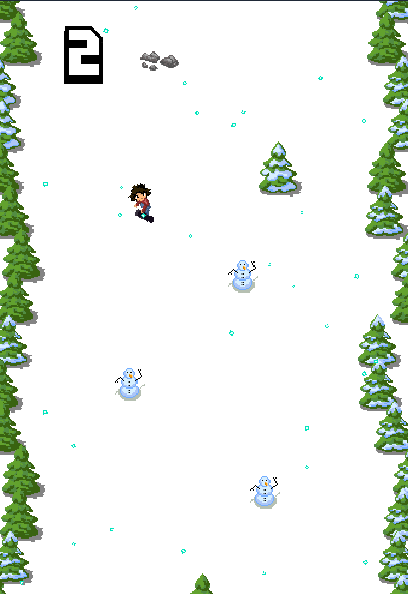
Top Center: Current score (usually calculated by obstacles cleared or distance traveled).
Top Corners: High score, a constant reminder of how far you are from beating your personal best.
Character Center: Your skier. Watch his movement closely; there is a subtle leaning animation when he turns, which is a vital visual cue for timing and "feel."
Chapter 2: Survival Guide — Know Your "Mountain Rivals"
In Tap Skier, nature is your only opponent. Understanding the characteristics of obstacles is the prerequisite for longevity.
2.1 Common Obstacles: Trees and Rocks
These are your most frequent killers.
Evergreen Trees: Distributed vertically, occupying about one character's width. They often appear in rows, forcing you to perform rapid, successive turns.
Large Rocks: Slightly wider than trees and visually more intimidating. Hitting a rock results in an instant Game Over.
2.2 The Hidden Killer: The Avalanche
In some advanced levels or mobile versions, a roaring avalanche chases you from behind.
Speed Pressure: The avalanche means you cannot "dilly-dally." If you turn too frequently, causing your vertical descent speed to slow down, the avalanche will swallow you.
Strategy: Try to maintain longer diagonal slides and only turn when necessary to keep enough gravitational acceleration.
Chapter 3: Advanced Secrets — How to Break the 1000-Point Mark?
To earn a spot on the leaderboard, pure reaction isn't enough. You need to master these high-level strategies.
3.1 Pre-empting is Key
The biggest mistake beginners make is "tapping only after seeing the obstacle." At high speeds, that is usually too late.
Look Ahead: Your eyes should not be fixed on the skier, but rather on the bottom 1/3 of the screen. Plan your route 3–4 seconds in advance.
Turn Early: If you see a tree ahead on the right, you should tap to turn when you are still two or three body-lengths away, using momentum to glide past it safely.
3.2 Rhythm and Cadence
Tap Skier is essentially a rhythm game. When obstacles are evenly distributed, your taps should be a steady "tap, tap, tap."
Mental Metronome: Try to keep a beat in your head. Regular tapping helps relieve tension and prevents panic when sudden obstacles appear.
3.3 The "Near Miss"
While risky, staying close to obstacles is necessary for tight maneuvers.
The Hitbox: Learn the skier’s collision area (hitbox). You will find that the tips of the skis are slightly more "forgiving" than they look. Learn to exploit this tiny margin of space.
Chapter 4: Character System — Unlock Your "Skiing Squad"
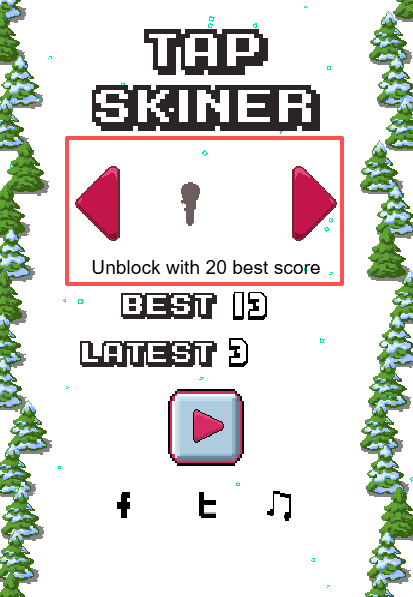
The game features multiple unlockable characters (usually around 13, depending on the version). Changing characters isn't just about aesthetics; it provides a fresh feel to reduce gameplay fatigue.
Unlock Conditions: Most characters are unlocked by reaching specific milestones:
Cumulative Score: Reaching a total distance (e.g., 10,000 meters).
Single High Score: Clearing a certain number of obstacles in one go.
Achievements: Playing for consecutive days, etc.
Personalized Experience: From classic pro skiers to funny characters in animal onesies, each character comes with unique 8-bit sound effects.
Chapter 5: Mindset — The Discipline of a Pro Skier
Tap Skier is a game designed with a high "frustration factor." You might crash in the 2nd second or lose everything in the 200th second due to a slight finger twitch.
Accept Failure: Every crash is training your muscle memory.
Avoid "Over-Tapping": When panicked, it’s easy to double-tap. This causes the skier to jitter in place and almost always leads to a crash. Keep your fingers light and every tap intentional.
Short Bursts: This game requires high-intensity focus and isn't suited for long, continuous play. Play for 10-15 minutes, rest your eyes, and your performance will improve.
Conclusion: Start Your Polar Descent
Tap Skier proves that you don't need flashy 3D effects to create palm-sweating tension. It challenges the most primal human reaction instincts and rewards the "flow state" brought by total concentration.
Now, open the game, take a deep breath, and stare at the snowy path ahead. Remember: Don't look at where you are; look at where you are going. Good luck on the slopes—become a true mountain legend!
[Strategy Summary Table]
| Key Point | Action | Pro Tip |
| Control | Single Tap | No mindless double-tapping |
| Vision | Focus on bottom of screen | Plan route 2-3 seconds ahead |
| Speed | Maintain vertical drop | Avoid frequent, tiny adjustments |
| Mindset | Stay Calm | Restart immediately after a fail to keep the "feel" |